Draft Strategy From The 1.05 In 2026 Fantasy Football: Choosing Between JSN and CMC
Chris Allen breaks down optimal fantasy football draft strategy for 2026 from the 1.05 draft slot.
So, I just got back from the Fantasy Football Expo up near the Pro Football Hall of Fame. If you haven’t been, go. It doesn’t matter if you’re someone like me who’s terminally online trying to figure out if Kimani Vidal is worth adding to their best-ball portfolio, or just a fan of this game we play every year. The ability to see everything positive about the industry, realized in a few days of camaraderie, is worth the trip.
Honestly, it didn’t take me long to see that spending time with friends in northeast Ohio has a connection to drafting from the 1.05. We’ve talked about what to do from the other slots. And there are loose guidelines for profiles to target from each position. But the five-hole is a vantage point where you can see the lessons come together. More importantly, you get a greater appreciation for the takeaways as you watch the draft unfold.

Join Our Newsletter
Trusted by 400,000+ fantasy football players. Get access to Fantasy Life's free award winning newsletter and tools, all in one step.
By registering or logging in, you agree to our Terms of Use and Privacy Policy.
Fantasy Football Draft Tip For The 1.05 In 2026
The Double-Edge Sword of Being an Elite QB
I don’t think I need to tell you what it takes to find your QB in the upper echelon of "Players to Draft" articles.
The Konami Code still reigns as the booster for fantasy scoring. But the problem back in 2016 was that fewer QBs displayed the mobility to take advantage of how we score the position. Now, with playcalling innovation and younger talent coming into the league, the hybridization of being a passer has become more common.
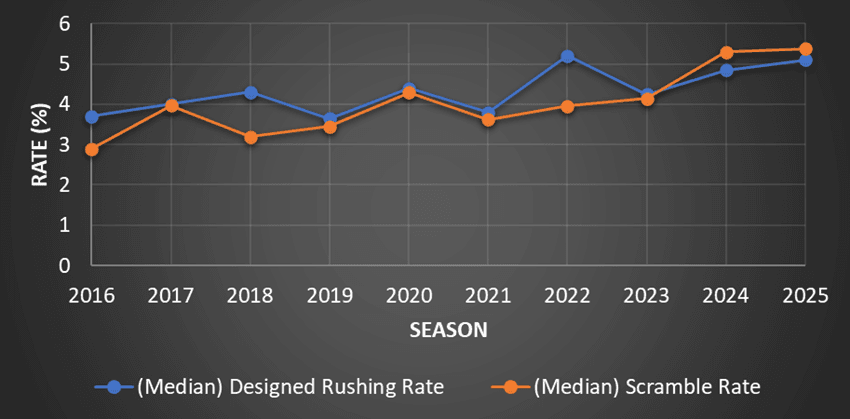
Since 2016, the median designed rushing rate (min. 200 dropbacks) has come up by 37.8%. Scrambling is almost double what it was a decade ago (up 86.2%). And to go with the evolved offensive scheming, come the gods we watch on Thursdays, Sundays and Mondays. There’s been a 23.1% increase in the number of QBs that surpassed the league median designed or scramble rate. That’s good! Well, for the league, it’s great as new styles of play become talking points. However, for drafters, more isn’t necessarily better.
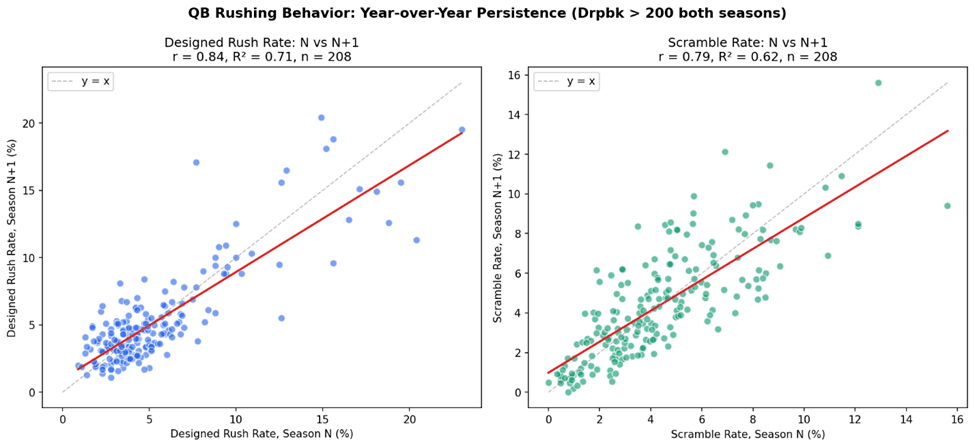
Blerd Tip: Year-over-year charts (or “n vs n+1” graphs) compare one value to the next in the series to measure if there’s any correlation between them. The R2 number you see above each plot indicates how close the red line matches the behavior of the data set. The closer to 1.0, the stronger the connection.
I took a look at year-over-year mobility rates (designed runs and scrambles) for QBs to see how much things change each season. Intuitively, once a signal caller establishes their identity, they’re apt to keep it. And at face value, that should lead us to prioritize any trigger man with a penchant for throwing caution to the wind and scampering past the line of scrimmage. But we need more than just rushing production.
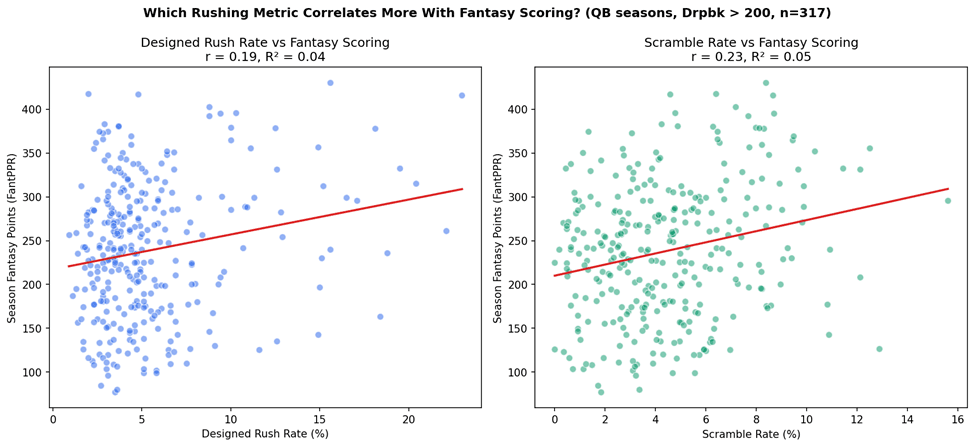
As I said earlier, running is just a booster. Using a similar process to build the previous charts, the sample indicates the designed rushing or scrambling doesn’t have a strong impact on fantasy totals. But Josh Allen and Lamar Jackson have been perennial early-round picks. The differentiator? They also happen to be efficient throwers of the football, too.
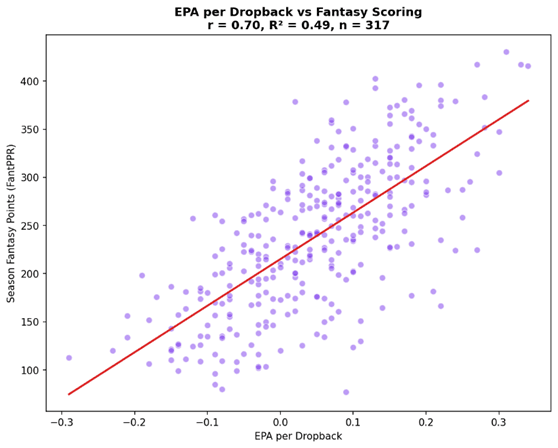
Admittedly, EPA per dropback does include scrambles since they are an intended pass play gone awry. So, there’s some bias in the R-squared value. But the general takeaway is the same. QBs need to be efficient passers, on top of running, to ascend into elite territory. That’s why dual-threat QB1s make up the majority of the Top 12 most seasons (only one season since 2016 saw sub-median rushers dominate at QB) and a Joe Burrow or Matthew Stafford poke through.
Anyway, let’s see if there are any potential breakout candidates from the later rounds with the rushing and throwing acumen to challenge for a top-12 spot by the end of the year.
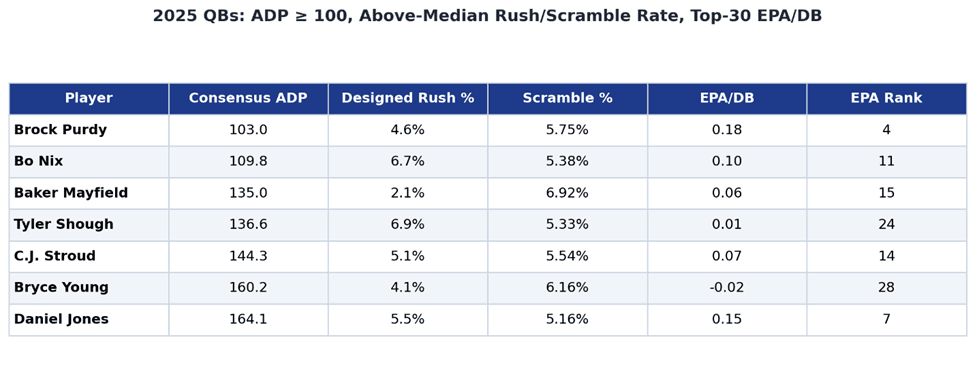
Again, if we can assume their tendencies to take off remain, and they’ve already demonstrated the capacity for competitive QB play, we’ve already got the makings of a weekly starter. We just need the situation to improve in order for a story of how they jump a tier to make sense.
Take Tyler Shough for example.
After taking over in Week 9, the 26-year-old rookie finished the year 13th in EPA per dropback. And that was with first-time HC Kellen Moore calling plays and Shough throwing passes to Mason Tipton, Devaughn Vele and Dante Pettis along with Chris Olave. A full offseason to get more comfortable with Moore’s system, along with adding Jordyn Tyson, is an easy stroll down Narrative Street, lending credence to the idea of waiting to draft your starting QB until the later rounds.
Now, let’s draft!
For reference, here’s the format I chose in our Draft Champion tool:
- 12 teams
- 0.5 PPR
- 1QB, 2RBs, 3WRs, 1TE, 1FLEX, 1K, 1DST, 6 Bench
You’re On the Clock at 1.05!
To be honest, the 1.05 is the first position where uncertainty about your opening pick becomes a factor. You’re almost hoping somebody falls to you. It’s not like the other guys have their warts. Bijan Robinson will have one of Tua Tagovailoa or Michael Penix throwing to him. Ja’Marr Chase and Puka Nacua have QBs with signs reading “injury risk” blinking behind them. But for the guys typically available at fifth overall, there’s an extra pause before clicking on them.
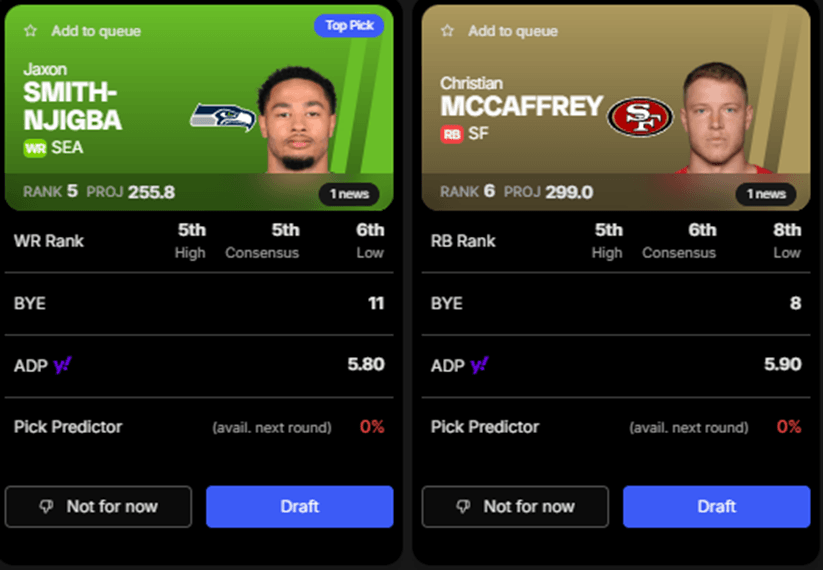
The bear case for Jaxon Smith-Njigba or Christian McCaffrey is simple. Their ’25 results are hard to reproduce. The latter is at the dreaded age cliff where production starts to decline. The former needed their QB to hit career-highs in almost every efficiency metric. McCaffrey’s opportunity buoys his price. With Smith-Njigba, his cost is the product of a bet on talent drafters have been willing to make since he came into the league.
- 2023: 17.0% (Target Rate), 1.32 (Yards per Route Run), 14.1% (Air Yard Share)
- 2024: 24.1%, 1.81, 29.4%
- 2025: 35.8%, 3.68, 50.0%
The Ohio State product showcased a diverse route tree the moment he got to Seattle. But when the WR playing opposite you looks like he came from Wakanda, get ready to learn slot or flanker, buddy. However, even as JSN stayed in the slot (77.4% interior route rate in ’24) and his workload went up, so did the first downs and the explosives.
Of course, that was last year. And the haters labeling the Seahawks’ newly multi-million dollar receiver as a ‘scheme merchant’ are waiting for his fall back to mediocrity. That might be a while.
- Routes w/out Play Action and Pre-Snap Motion: 33.5% (Sample Size), 35.6% (Target Rate), 3.46 (Yards per Route Run)
- Routes w/out Play Action: 73.5%, 36.0%, 3.03
When you remove as much of the ‘gimmicks’ from former OC Klint Kubiak’s scheme as possible, Smith-Njigba’s finesse as a route runner shines. Similar to rushing being a booster for QBs, pre-snap motion and play-action are the levers coaches can pull to get their guys into the right spot. But Seattle’s WR1 was lapping the field without them. So while it’s fair to expect some growing pains with new OC Brian Fleury, Smith-Njigba’s ability to earn targets and produce off them is still worth a first-round nod.
The Rest of the Early Rounds When Drafting From 1.05
So, let’s say I sold you on a WR in the first round. That’s one pick down. We’ve got at least 15 to go. And the Draft Assistant doesn’t make things any easier.
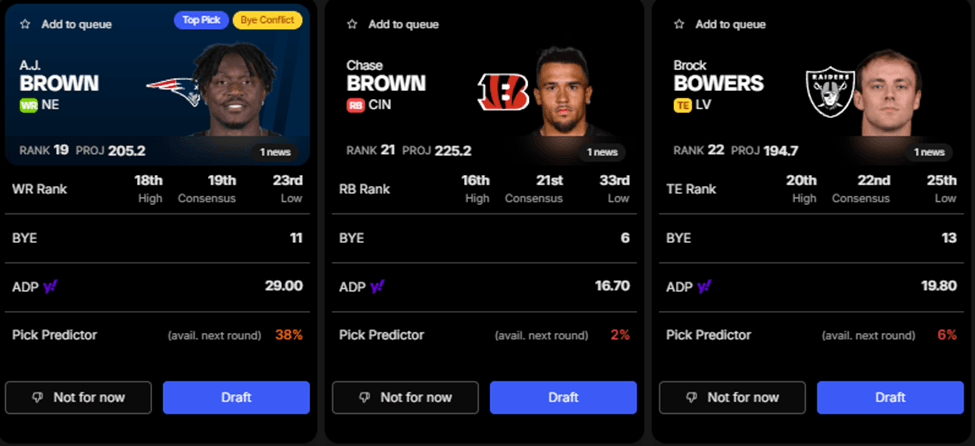
I set the league to require three starting WRs to force a decision point. Either we keep building on the position requiring the most weekly starters, stay balanced with an RB, or take a swing at a onesie. I went down each rabbit hole, but the simulator has a clear favorite.

“It’s not the note you play that’s the wrong note—it’s the note you play afterward that makes it right or wrong.” – Miles Davis
In other words, the grades aren’t an indicator of what’s to come. You are. Team 1 with two WRs now has to scramble at RB. The other two squads are missing out on top receivers. All of them have to make their next decision based on their last. Anyway, since we’ve built a few of these in the past, we can lean on a couple of lessons from the past to get through the remaining early rounds.
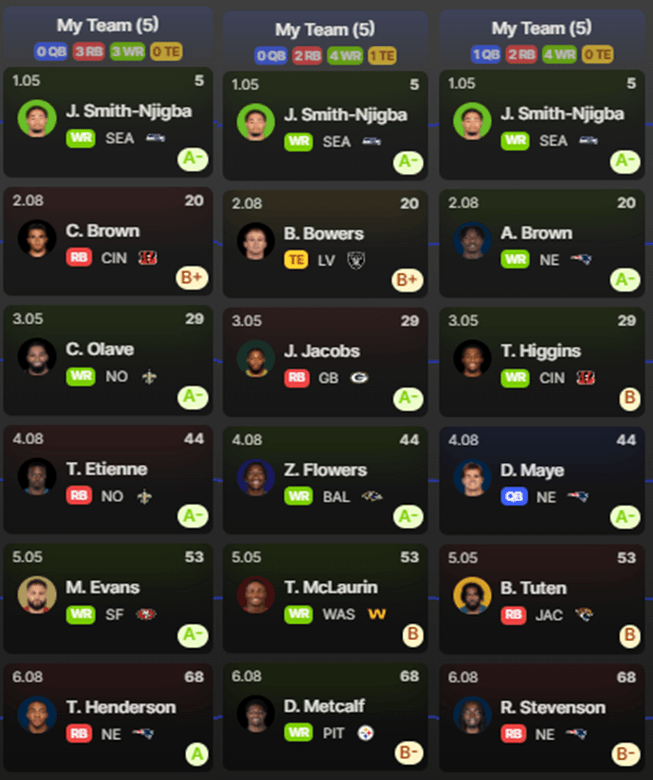
To evaluate Team 1, let’s look at Team 3. You’ll see I’ve taken both New England RBs at the same ADP. No, I’m not hedging. But how I’ve built the first team favors a profile like TreVeyon Henderson’s.
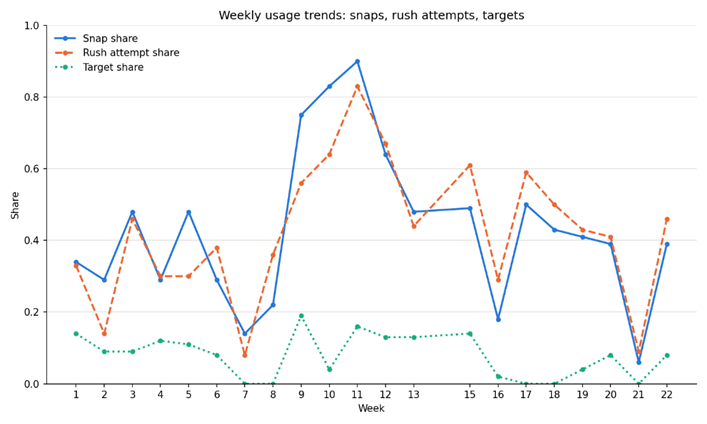
I used our Utilization Report game logs to visualize Henderson’s rookie season. No surprise, but we got the most out of the freshman when Rhamondre Stevenson was out. Plus, the only time both backs were active and Henderson took over the goal-line role was in Weeks 17 and 18 (i.e., when New England had the division title locked up). Normally, I’d treat the backfield ambiguity by prioritizing Stevenson. But as my RB3, I can watch the touch share evolve without it having a large impact on my roster. For Team 2, taking Brock Bowers was more about the receivers on the board near him.
- DeVonta Smith (PPR PPG): 15.3 (2024), 11.9 (2025)
- Malik Nabers: 18.2, 17.7
Smith and Nabers were the next WRs drafted after I took Bowers. Between the two, they have two top-10 finishes (Smith – WR9, 2022; Nabers – WR6, 2024). Bowers would’ve been the WR9 during his rookie campaign, projected for the same number of targets as Nabers, and isn’t coming off of a major surgery. Using the idea that TEs with WR1 outcomes can swing fantasy leagues, building around Bowers becomes a viable option.
Mid-Round Pitfalls When Drafting From 1.05 In Fantasy Football
Based on what we’ve got through six rounds, let’s lay out the main gaps for Team 3.
- Need an RB2
- Need a TE
- Need depth at WR
We’ve got a process for finding TEs. But RBs in the middle rounds are a bit different. Here’s a quick reminder.
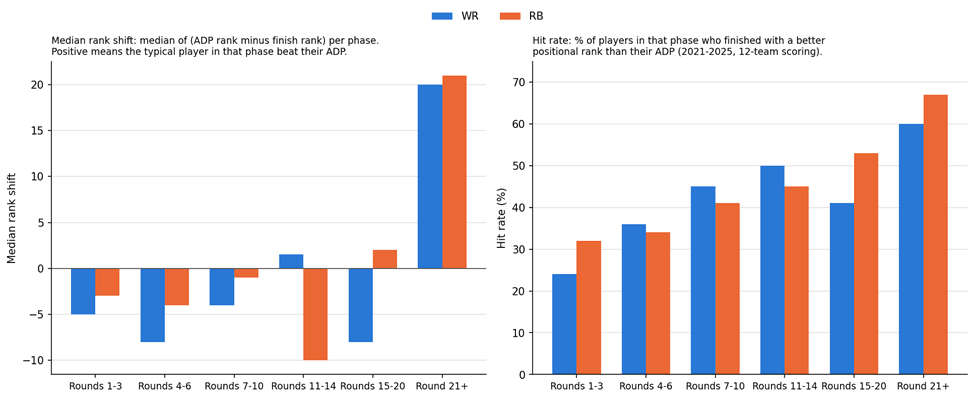
In short, there’s more volatility for RB output in the middle rounds. Results differ from pre-season expectations more in this area while hit rates grow. Said another way, how we think backfields will play out doesn’t always reflect reality. In either case, I took a few calculated shots to keep my roster in good shape.
- 8.08: Blake Corum
- 9.05: Kenneth Gainwell
- 10.08: Jonathon Brooks
Each has a distinct path to either spurts as the lead back or outright claiming the job should things break their way.
Corum has loosened Kyren Williams’ grip on the RB1 role in LA with a 34% share of the touches in ’25. But Williams still gets the money touches. It’s hard to guess what HC Sean McVay means by Corum being a ‘big factor’ for the Rams, but any progression in his duties gives him value.
Gainwell is coming off a season with a 16% target rate. His previous team’s scheme and play-calling were haphazard at best. He now steps into an offense with more upside and a clear pass-down role (with contingent upside should Bucky Irving get hurt) and a now-healthy QB in Baker Mayfield.
Brooks is the wildcard here. Carolina is already dealing with injuries along their offensive line, and we haven’t even gotten to the preseason. However, Brooks did jump to an 8% target share in his one game with meaningful action before reinjuring his knee. The former Longhorn came out with rushing and receiving acumen worthy of a Day 2 pick, despite the health red flags. Given he’s had an extra year to recover, Brooks becomes another archetype of RB to stash if you’re looking for players that could outkick their ADP.
Building A Championship Roster From The 1.05 In 2026
All right. Let’s see how we did. Remember, it’s not about winning the draft. We should try to glean where our weaknesses are after we assemble a team. How quickly we need to attack the waiver wire or screening bench players as potential Week 1 drops may need to happen before the first kickoff.
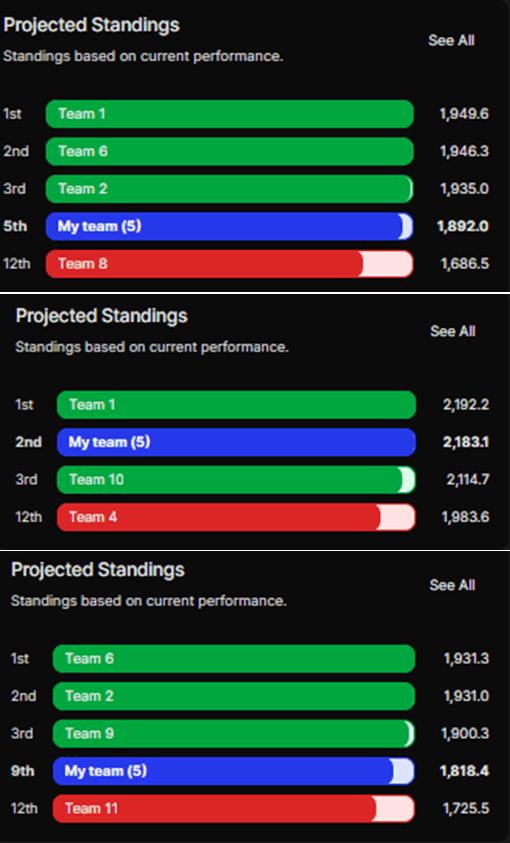
Admittedly, I tried to redo Team 3’s roster starting from the middle rounds almost a dozen times. I couldn’t get a projected finish above 8th. I had taken on too much risk earlier in the draft.
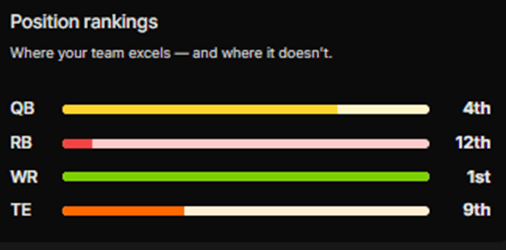
Without a stronger QB or TE to offset waiting on RB, projections indicate I’d be off to a slow start. But again, that’s why the middle rounds were about embracing the unknown. Because despite harboring unknowns at both RB starter slots (Tuten, Stevenson), adjusting for them by buying into ambiguous backfields is the best way to ensure I didn’t play any wrong notes in the early rounds.
Join Our Newsletter
Trusted by 400,000+ fantasy football players. Get access to Fantasy Life's free award winning newsletter and tools, all in one step.
By registering or logging in, you agree to our Terms of Use and Privacy Policy.
Players Mentioned in this Article






Published Updated